
OSCAR-PINQ (2023-2024)
OSCAR-PINQ (Pulsed Integration and Novel Quantum concepts) is aimed at integrating quantum sensors with more advanced operational regimes and exploring novel concepts for Earth Observation.
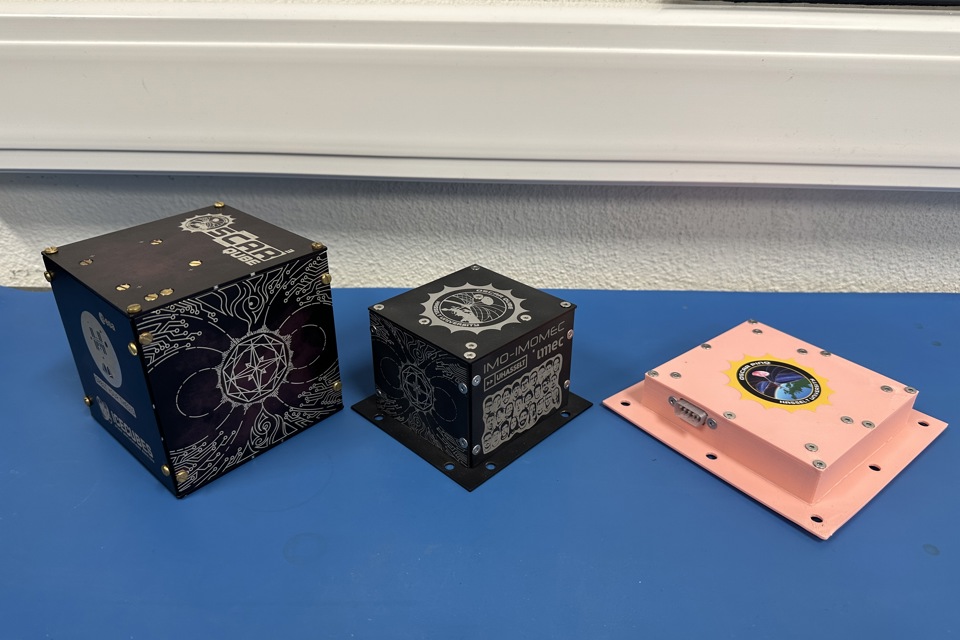
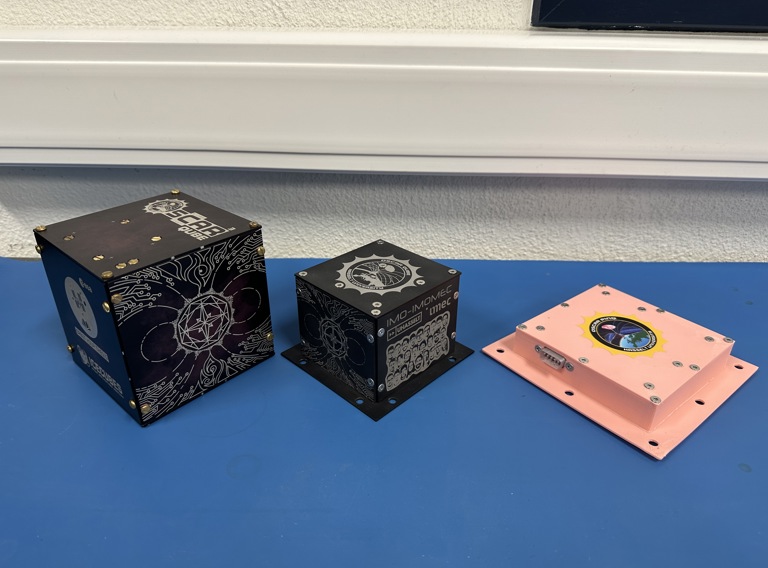
About the project
Following the submission of the proposal in December 2023 and its subsequent selection in February 2024 under the ESA Academy Experiments Programme. It was assigned to ESA Space Rider 1, the maiden flight of ESA’s reusable, uncrewed orbital laboratory. This is an autonomous robotic laboratory that will fly to space to perform experiments for 2 months and then come back all by itself. Space Rider will launch on a Vega-C rocket and provide power, thermal control, data handling and communication to all its experiments.
OSCAR-PINQ (Pulsed Integration and Novel Quantum concepts) emerged as the interdisciplinary team’s next-generation flagship quantum magnetometer. The project is currently in active development; its detailed design has been officially approved and the payload is undergoing comprehensive functional and environmental testing ahead of its maiden spaceflight. The mission is currently targeted for launch in Q1 2028 aboard ESA’s Space Rider vehicle.
OSCAR-PINQ is not merely a smaller QUBE+. Its central advance is the move from mainly continuous-wave measurement to coherent pulsed quantum sensing. That makes it possible to control which magnetic frequencies the sensor detects. We also target a much higher sensitivity of sub-nT/√Hz performance. Additionally, our earlier missions primarily proved that the technology worked in space. OSCAR-PINQ aims to use the improved measurements for geomagnetic mapping, space weather and exploratory geophysical research. This is also the first time that our sensor will operate in the space environment and will return to earth so we can inspect after flight and compare its post-flight performance to its calibration.
Goals
The goal of OSCAR-PINQ is to demonstrate that an advanced NV-diamond quantum magnetometer can be made sufficiently small, sensitive and reliable for widespread use on small satellites. The OSCAR teams aims to reduce the instrument to approximately 0.4U while reaching sub-nanotesla sensitivity over a wide measurement range and also wants to integrate pulsed quantum-measurement protocols to measure both static and fast changing magnetic fields. One possible application of these different changing magnetic fields is to identify magnetic signatures associated with volcanic or tectonic activity from space.
Results
There are no final in-orbit scientific results yet, because OSCAR-PINQ has not flown. The results achieved so far are engineering and ground-test results. The preliminary design phase was completed and in June 2026 OSCAR-PINQ officially passed its Critical Design Review. ESA experts approved the detailed design, allowing the project to proceed into Assembly, Integration and Testing. The team has completed the design of the sensor’s electronics, embedded software, FPGA functions, mechanical structure and thermal concept, supported by almost 600 pages of project documentation. The next results will come from integration and qualification testing, including functional, thermal-vacuum, vibration, electromagnetic-compatibility and performance tests.